This post is about my own story and mentions my own book, The Mortgage Playbook. This is my own book, written and sold by me. When you buy through a link on this page, you are buying directly from the author.
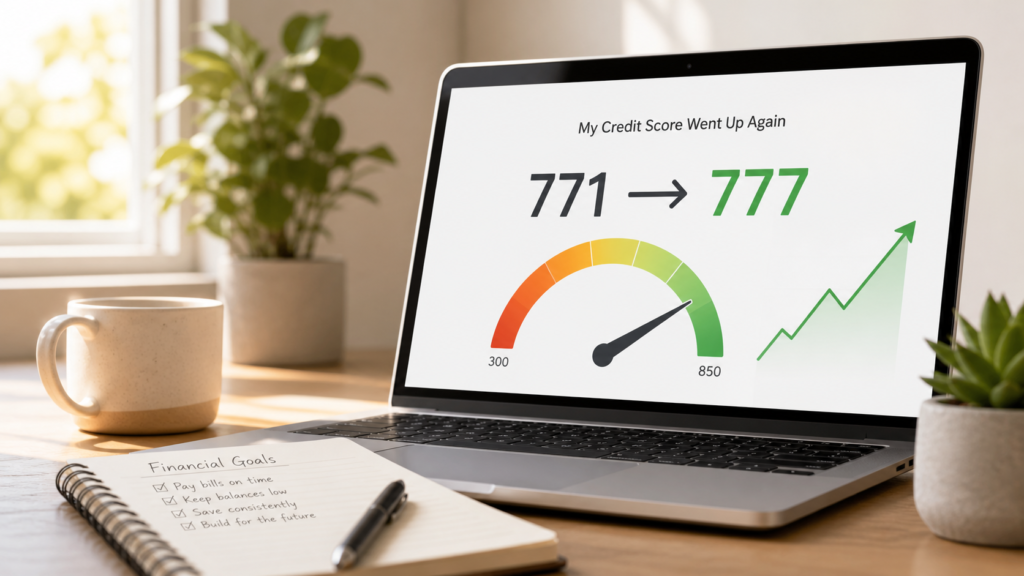
My credit score just went up again. Not by a lot — by six points. But if you have ever watched a number like this climb out of the basement, you know six points can feel like sixty. My real Experian report used to sit at 771. It now sits at 777 — and it is still moving in the right direction.
No actor. No stock photo. That is my actual credit report, and this is the short video of the moment I saw the rise:
Watch it on HustleTube — my own video platform.
From Destroyed to 777
After my divorce, my credit was destroyed. Not dipped — destroyed. The kind of score that gets doors closed in your face: apartments, cars, even jobs suddenly feel out of reach. The “fix my credit” companies all had the same answer: pay them a fortune and wait, and they would handle things I could not see.
I did not have a fortune. So I handled it myself. I pulled my own reports, faced every ugly line on them, and rebuilt step by step — the same way you eat an elephant. It was not fast and it was not magic. But it worked. The same credit that once embarrassed me is the credit that put me in my own home. Buying that house was a dream come true, and the score has kept climbing ever since — 771, and now 777.
Is a 777 Credit Score Good?
Yes. On the FICO Score 8 scale (300–850), 670–739 is considered Good and 740–799 is Very Good. A 777 sits solidly in the Very Good band. In plain English, that means lenders see you as a safe pair of hands: better approval odds, better interest rates, and more negotiating power on the things that matter — a home, a car, a business loan.
Here is the part nobody tells you when your score is in the gutter: the number is not a life sentence. It is a snapshot. Snapshots change.
What a Higher Score Actually Changes
A rising score is not just a number to screenshot. It changes real life, quietly, in a dozen places at once. Landlords stop asking for double deposits. Car dealers stop sliding you the worst rate on the sheet. Credit card offers go from “secured card with a fee” to actual rewards cards competing for your business. Even things like insurance premiums and utility deposits can ease up, because a lot of companies quietly check credit when they set your price.
And then there is the big one: a home. A Very Good score does not just get you approved for a mortgage — it gets you approved at a rate that can save you tens of thousands of dollars over the life of the loan compared with the rates offered to damaged credit. That is the real prize I was chasing the whole way up, and it is why I say your situation today does not have to be your situation forever.
Your Credit Can Rise Too
I am not special. I am a veteran who went through a divorce, watched his credit fall apart, and decided his situation at that moment did not have to be his situation forever. If a score can rise after all that, yours can rise from wherever it is sitting right now.
The full game plan I used — my exact steps, in my own words — is inside my book, The Mortgage Playbook. This post is the proof it works. The book is the how. You can find it in my store, along with the rest of my credit and home-buying guides.
Keep reading: watch more of the comeback on HustleTube, or head straight to the FreebieBro store and start your own rise.
Frequently Asked Questions
Is a 777 credit score good?
Yes. On the FICO Score 8 scale, 740–799 is the Very Good range, so 777 is a strong score. It generally means better approval odds and better interest rates on homes, cars, and loans.
Can a destroyed credit score really come back?
Yes. A credit score is a snapshot, not a life sentence. Theo's score was destroyed after his divorce, and by rebuilding it himself he reached 771 — and now 777 — and bought his own home.
How long does it take to rebuild credit?
There is no overnight fix, and anyone promising one is selling something. Rebuilding is a step-by-step process measured in months and steady habits, not days. The important part is starting.
Where can I get the full game plan Theo used?
It is inside his book, The Mortgage Playbook, available in the FreebieBro store at freebiebro.org/store. The book lays out his exact steps in his own words.