Disclosure: This page may contain affiliate links. I may earn a commission at no extra cost to you if you purchase through one of these links.
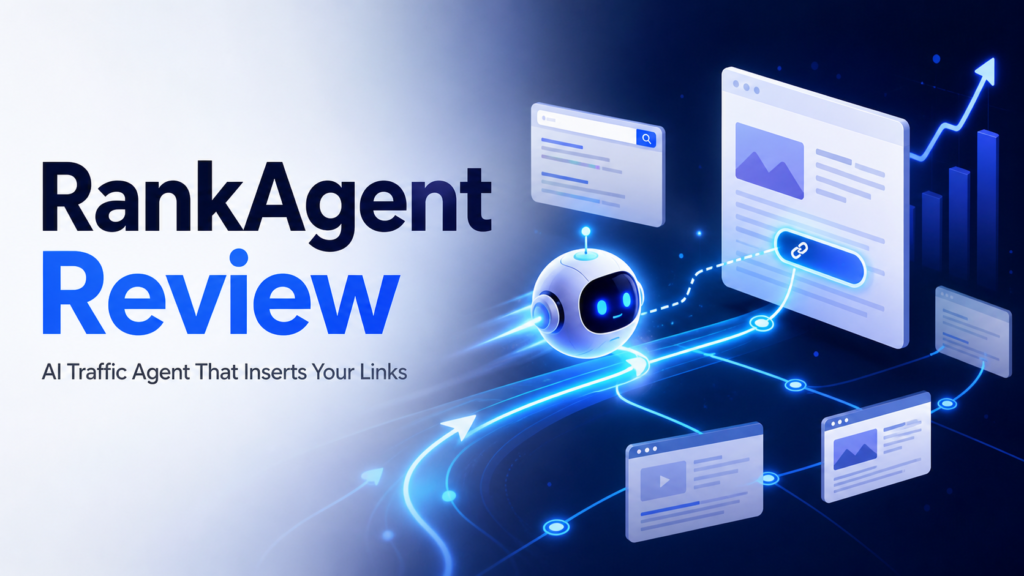
AI assistants and AI-powered search results are changing how people discover products, services, and information. RankAgent enters this developing market as an AI Traffic Agent That Inserts Your Links or offers into the AI discovery ecosystem. Its sales message highlights platforms such as ChatGPT, Gemini, Claude, Grok, Perplexity, and Google AI Overviews. For affiliate marketers and small business owners, that proposition sounds attractive—but it is important to understand what the product may do, what no tool can guarantee, and how it could fit into a responsible marketing strategy.
What Is RankAgent?
RankAgent is marketed as the “world’s first AI traffic agent” designed to help businesses place their links or offers in content that may be discovered, processed, or referenced by major AI platforms. The central idea is to increase the presence of a website, brand, product, or offer in an online environment where users increasingly ask conversational tools for recommendations and answers.
This approach is related to AI visibility, generative engine optimization, brand mention building, and traditional search engine optimization. Instead of focusing only on conventional Google rankings, marketers are beginning to consider how their content appears across AI-generated answers and summaries.
The promotional claim refers to more than 2.5 billion daily AI answers. Treat that figure as part of the product’s marketing message rather than a promise that an individual campaign will reach that audience. Access to a large ecosystem does not automatically mean that every submitted link will appear in an AI response. WebMint Review: AI SuperProgrammer™ That Turns Your Voice or Text Into Websites
Can a Tool Directly Insert Links Into AI Answers?
The phrase AI Traffic Agent That Inserts Your Links should be interpreted carefully. Major AI companies control how their systems collect information, select sources, generate answers, and display citations. Third-party marketing software generally cannot force ChatGPT, Gemini, Claude, Grok, Perplexity, or Google AI Overviews to publish a specific link on demand.
A realistic AI visibility tool may instead help create, organize, distribute, or optimize web content that AI systems could discover. It may also support campaigns intended to increase brand mentions, citations, or references across publicly accessible pages. These activities can improve the possibility of discovery, but they cannot ensure inclusion in a particular answer.
Before purchasing RankAgent, review its demonstration and documentation to establish exactly what “inserts” means. Look for a clear explanation of where content is published, whether you retain control of it, how links are used, and whether placements remain available over time.
Why AI Answer Visibility Matters
Online discovery no longer follows a single path. A potential customer might search Google, ask Perplexity to compare products, request a recommendation from ChatGPT, or read a Google AI Overview before visiting a website. This creates new opportunities, but it also makes attribution and optimization more complicated.
For small businesses, AI visibility may support several objectives:
- Helping AI systems understand what a business offers.
- Building consistent brand and product references online.
- Making useful content easier to discover and summarize.
- Creating additional pathways from informational research to a website.
- Supporting existing SEO, public relations, and content marketing campaigns.
The strongest strategy is not to chase AI citations in isolation. AI-focused promotion works best when it supports a credible website, genuinely useful content, clear product information, and a positive user experience.
Who Might Consider RankAgent?
Affiliate Marketers
Affiliate marketers could use an AI visibility workflow to support comparison articles, tutorials, buying guides, and product-focused content. Any affiliate relationship should be disclosed clearly, and promotional claims should be based on accurate product information.
Small Online Businesses
A small business may want to strengthen references to its services, location, specialty, or product category. RankAgent may be worth investigating if it simplifies content distribution or AI-oriented optimization without requiring a large technical team.
Agencies and Freelancers
Marketing providers may see AI visibility as an additional service. However, agencies should avoid promising clients that a link will appear in a named platform or that a campaign will produce a fixed amount of traffic.
Content Creators
Bloggers, educators, and niche publishers may use AI discovery campaigns to extend the reach of their existing content. The original page still needs to offer clear value if a visitor follows the link.
Potential Benefits of an AI Traffic Agent
RankAgent’s main appeal is convenience. Managing content for multiple discovery channels can be time-consuming, especially for a beginner. A centralized workflow could make planning and execution more manageable.
A Broader Discovery Strategy
Traditional SEO remains useful, but it is no longer the only consideration. A tool focused on AI platforms may encourage marketers to structure content around direct questions, concise explanations, entities, topics, and verifiable information.
Faster Campaign Setup
If RankAgent automates repetitive research, content preparation, or distribution tasks, it could reduce manual work. The exact level of automation should be confirmed in the current product demonstration rather than assumed.
Support for Commercial Links
The ability to build campaigns around a product page, lead magnet, service page, or affiliate offer may be useful. The destination should match the user’s intent and provide more value than a simple sales pitch.
Beginner-Friendly Positioning
The “press of a button” message suggests ease of use. Even so, beginners should expect to make strategic decisions about keywords, audiences, landing pages, claims, and campaign quality. Automation can assist with execution, but it does not replace judgment.
Important Limitations and Risks
No responsible RankAgent review should ignore the uncertainty surrounding AI-generated answers. These systems change frequently, and the same question can produce different answers based on wording, location, account settings, model version, and available sources.
- No guaranteed inclusion: A campaign cannot reliably force an independent AI platform to display a particular URL.
- No guaranteed traffic: A mention or citation does not mean users will click.
- No guaranteed rankings: AI visibility and conventional search rankings use different, evolving signals.
- Quality still matters: Thin, repetitive, or misleading material may damage trust.
- Platform changes are unavoidable: AI providers can alter their models, citation systems, and policies.
- Tracking may be incomplete: Referral data from AI assistants can be inconsistent or difficult to attribute.
You should also consider compliance. Avoid fabricated endorsements, unsupported comparisons, hidden affiliate relationships, and exaggerated income claims. If RankAgent generates content automatically, review every item before publishing or distributing it.
How to Evaluate RankAgent Before Buying
1. Watch the Full Demonstration
Look beyond headline claims. Identify the exact steps between entering a link and creating a campaign. Determine whether RankAgent publishes content, suggests content, submits pages, builds mentions, or performs another process.
2. Inspect the Placement Method
Ask where your links can appear and who controls those locations. Find out whether placements are on owned properties, third-party websites, public profiles, generated pages, or another type of asset.
3. Review Usage Limits
Check the number of projects, links, campaigns, exports, or generated assets included with the purchase. Also check whether any external services require additional fees.
4. Examine the Refund Terms
Read the current refund policy on the checkout page. Note the eligibility period, exclusions, and required contact process before completing a purchase.
5. Assess Content Control
Confirm whether you can edit titles, descriptions, calls to action, and factual claims. Human review is essential when your reputation or affiliate compliance is involved.
6. Compare the Cost With Manual Alternatives
Consider whether you could achieve a similar objective through helpful articles, digital PR, expert contributions, business listings, structured data, and conventional SEO. Automation is valuable only when it saves enough time or improves organization.
Practical Steps for Using RankAgent Responsibly
Step 1: Choose One High-Quality Destination
Start with a page that solves a clear problem. It might be an in-depth product review, a service page, a comparison guide, or a free resource. Check that it loads correctly, works on mobile devices, and includes a clear next step.
Step 2: Define the User’s Question
AI answers are typically prompted by questions. Instead of targeting a broad phrase such as “email software,” focus on a specific need such as “What email platform is suitable for a new local business?”
Step 3: Provide Verifiable Information
Use accurate product names, features, use cases, limitations, and pricing information. Avoid stating that a product is the best unless you explain the criteria and have sufficient evidence.
Step 4: Create a Relevant Campaign
Enter your destination and topic into RankAgent according to its current instructions. Select wording that closely matches the content on your page. Do not use unrelated popular topics merely to attract exposure.
Step 5: Review Every Output
Check grammar, links, factual accuracy, disclosures, and brand consistency. Remove invented claims or language that implies guaranteed outcomes.
Step 6: Measure Meaningful Signals
Use analytics to monitor referral visits, engaged sessions, leads, and conversions where possible. You can also periodically test relevant questions across AI platforms, although results may vary between users and over time.
Step 7: Improve the Destination Page
If people visit but leave quickly, the problem may be the landing page rather than the campaign. Improve the introduction, answer common questions, add transparent disclosures, and make the next action obvious.
Example Campaign for a Small Business
Imagine a small bookkeeping company serving online retailers. Its owner has published a detailed guide explaining how e-commerce sellers can prepare monthly records. The guide includes a checklist and a link to request a consultation.
The owner could build a RankAgent campaign around questions such as “How should a small online shop organize bookkeeping records?” The campaign should point to the educational guide rather than sending every visitor directly to a sales form.
This creates a better match between the question and the destination. If the guide is discovered or referenced, readers receive practical help first. Some may then explore the company’s services. There is no certainty that an AI platform will cite the guide, but the campaign supports a useful, customer-centered content strategy.
Is RankAgent Worth Considering?
RankAgent may appeal to marketers who want to explore AI-driven discovery without manually coordinating every part of a campaign. Its value will depend on the actual placement process, content quality, usage limits, current price, and how well it complements your existing marketing assets.
It should not be treated as a replacement for SEO, persuasive writing, customer research, or a trustworthy website. It is better viewed as a possible visibility tool within a broader strategy.
If you are interested in testing an AI Traffic Agent That Inserts Your Links, review the product presentation and terms carefully before deciding. You can visit the official RankAgent offer here. This is an affiliate link, which means the publisher may earn a commission if you purchase through it, at no additional cost to you.
Conclusion
AI-generated answers are becoming an important part of online research, making AI visibility a reasonable topic for businesses to explore. RankAgent offers an ambitious solution centered on promoting links and offers across the wider AI discovery landscape.
The opportunity should be approached with realistic expectations. No external tool can guarantee that a specific AI assistant will display your link, send traffic, improve rankings, or produce revenue. Focus on accurate content, relevant destinations, transparent promotion, and careful measurement. If RankAgent’s demonstration confirms that its workflow meets your needs, it may be a useful addition to your marketing toolkit.
Frequently Asked Questions
What is RankAgent?
RankAgent is marketed as an AI traffic and visibility tool that helps users promote links or offers within the broader ecosystem of content discovered by AI assistants and AI-powered search experiences.
Does RankAgent guarantee links in ChatGPT or Google AI Overviews?
No guarantee should be assumed. Major AI platforms independently control their answers, sources, and citations. Review RankAgent’s current documentation to understand how it creates or distributes potential visibility assets.
Can RankAgent guarantee website traffic?
No. Even when a brand or page is mentioned, users may not click the link. Traffic depends on relevance, placement, user intent, the destination page, and factors outside the tool’s control.
Is RankAgent suitable for beginners?
Its marketing emphasizes a simplified workflow, which may interest beginners. Users still need to select appropriate topics, verify content, disclose affiliate relationships, and track campaign performance.
Can affiliate marketers use RankAgent?
Affiliate marketers may be able to build campaigns around reviews, tutorials, comparisons, and offers. They should follow applicable advertising rules and the terms of both the affiliate program and publishing platforms.
What should I check before purchasing?
Review the demonstration, placement method, usage limits, content controls, refund policy, support options, and any additional costs. Confirm that the workflow matches your goals before buying.